The Blackwood house as castle and sanctuary
We Have Always Lived in the CastleThe Blackwood house as castle and sanctuary is both a material shelter and a way of drawing a boundary against the world. Before its destruction, its rooms embody inherited family order, domestic care, and secrets that outsiders can only guess at. After a fire and a village attack leave it broken open, Mary Katherine and Constance make it secure again by narrowing access, covering windows, and retreating into the rooms they can still use. The house’s transformation—from enclosed home to exposed ruin and then guarded refuge—makes safety inseparable from seclusion.
The Ordered House and Its Hidden History
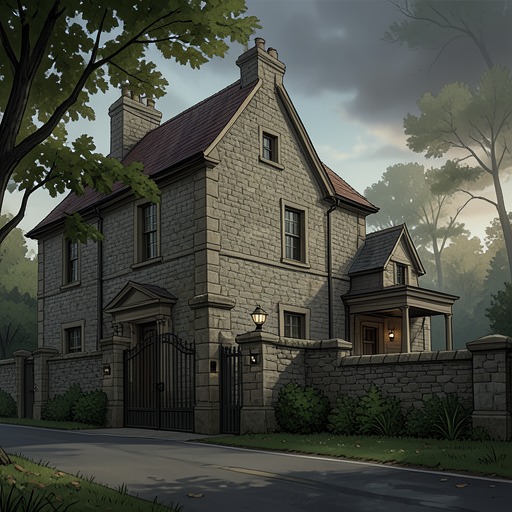
Before the house is wrecked, its authority resides in ordinary arrangements: a place at the dinner table, dishes put away, and household objects kept where they belong. Mary Katherine considers it vital to return for dinner with Constance, Uncle Julian, and Charles; an empty place would violate the family’s shared ritual. Looking at the house in the gathering darkness, she sees it as sound and nearly clean, a home she loves and expects to be put right. Inside, however, the kitchen still holds anger, and Charles’s voice carries through it. The apparent order of the rooms does not mean the household’s past is settled.
The sugar bowl makes that tension tangible. After the family poisoning, Constance empties and scours the heavy silver heirloom with boiling water before the doctor or police arrive, although the other dinner dishes remain on the table. She later explains the washing by saying there was a spider in it; the account also becomes the explanation she gives the police. Helen Clarke recalls the more incriminating circumstances: Constance had cooked and served dinner, watched the family die without calling a doctor in time, and washed the bowl. The house’s domestic objects thus belong both to a routine of care and to a history that routine cannot safely disclose. The careful handling of a family heirloom is inseparable from the attempt to erase what happened around it.
Inherited possessions also mark the house as a store of family time. Charles has taken old saucers from the pantry and scattered them through the rooms; one lies in the bedroom beneath his burning pipe without cracking. Mary Katherine brushes the saucer and pipe into the wastebasket. Later, the villagers’ destruction makes such disorder far more than a misplaced object: it tears into the accumulated things through which the household recognizes itself.
The House Opened to the Outside
The attack turns domestic space inside out. A kitchen table lies on its side against the door; chairs are smashed, dishes and food broken, and jam, syrup, and catsup shattered against the walls. The sink where Constance washes dishes is packed with broken glass. Silverware and cooking tools have been pulled from drawers and battered against the walls, while generations of linen are ripped from the sideboard and dragged across the floor. Even the rose-patterned sugar bowl lies near Mary Katherine, its handles gone. What had been contained, arranged, and repeatedly cared for is now exposed as debris.
The assault reaches into the pantry but does not destroy everything. The sugar has been found, and Mary Katherine imagines the intruders playing with it; cans are scattered and dented, cereal, tea, and crackers trampled, and cookies crushed. Yet Constance discovers that flour, salt, and potatoes remain hidden, and the cellar preserves are untouched. She brings up vegetable soup, strawberry jam, chicken soup, and pickled beef. Their survival gives the sisters something to eat and a practical beginning for household life, even as the floor remains gritty with the aftermath of the attack.
Other rooms register losses that cannot be repaired by salvaging provisions. Constance returns the Dresden figurine to its place beneath their mother’s portrait, and for a brief moment the drawing room seems to come together as it once did. The father’s safe, too heavy to carry farther, remains unopened near the door. But the sisters close the drawing-room door and never open it again. Above, the roof has been broken away: burned rooms and small patches of sky replace the ceiling that had once hidden them. Mary Katherine describes the house as a castle open to the sky, an image that holds together its grandeur and its exposure. Its elevated, turreted form no longer guarantees protection; the imagined possibility of watchers looking down through the ruined rafters makes the breach feel vertical as well as external.
Rebuilding a Sanctuary
The sisters make safety through selective closure rather than restoring the house to its former condition. They shut the drawing-room door, cover the tall dining-room windows with shutters, and lock the front door. The hall’s glass panels let them look outside from darkness without allowing passersby to see in. The upper rooms remain damaged and open to the sky, so the dependable center of the house contracts to the kitchen and the spaces immediately around it.
Mary Katherine covers the glass in the kitchen door and windows with cardboard, using a carton, a hammer, and nails left in the tool shed after Charles tried to mend a broken step. The resulting kitchen is clean but dim, a compromise Constance dislikes because she loves a bright room and sunshine while cooking. Mary Katherine proposes keeping the door open only when they can watch for cars, and she plans further barriers to prevent anyone reaching the back of the house. In one night, with Constance holding a flashlight, she piles broken boards and furniture from Mr. Harler’s heap across the narrow paths at either side, where trees and bushes grow close to the house. The barricades are not strong enough to stop every intruder; their value is that a person climbing over them would make noise and give the sisters time to bolt the kitchen door.
The refuge also depends on continuing the routines the attack tried to abolish. The sisters sift through the kitchen wreckage for usable cups, plates, bowls, and silverware, straighten what they can, and return the spices to their shelf. Constance cleans, cooks, and brings preserved food up from the cellar. When the sisters go to the vegetable garden, they leave the kitchen door open only because the barricades let them see an approaching person and run back if needed. They gather lettuce, radishes, tomatoes, cucumbers, berries, and melons, although ash from the burned house makes Mary Katherine reluctant to eat the produce dirty. The garden remains productive, but the smoke seems to her to have entered the ground for good. Shelter restores some daily life without undoing the fire’s presence.
A Ruin Seen from Outside
From the road, the house eventually appears less like a welcoming home than a strange landmark. The sisters learn that outsiders can see a ruined structure overgrown with vines, barely recognizable as a house, halfway between the village and the highway. The vines conceal the sisters’ eyes as they watch from within. For the children, the steps mark a threshold charged with danger; they warn one another that the ladies will get them if they climb them. One boy dares to call out the recurring rhyme about Merricat and Constance asking for tea, then flees with the others. That night, a basket of fresh eggs and an apologetic note appears on the doorstep.
The house’s sanctuary is therefore not a return to ordinary domestic openness. It is made by controlling sightlines, guarding approaches, and keeping the damaged rooms closed, while the sisters preserve food, garden, and care for one another inside. From outside, the house becomes an object of rumor and fear; from within, it remains a lived-in home whose smallest intact objects and repeated routines matter. Its castle-like quality rests less on walls that can repel every threat than on the sisters’ ability to create a protected interior within a ruin.